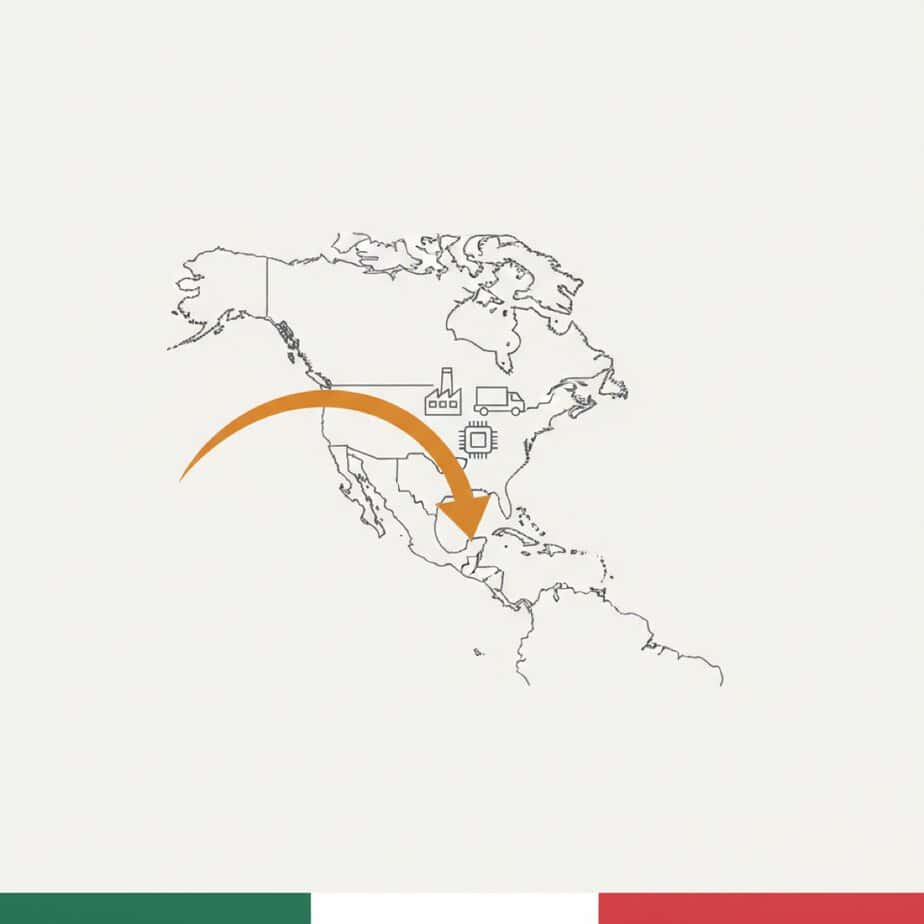
Why “nearshoring to Mexico” is the most important supply-chain story of the decade
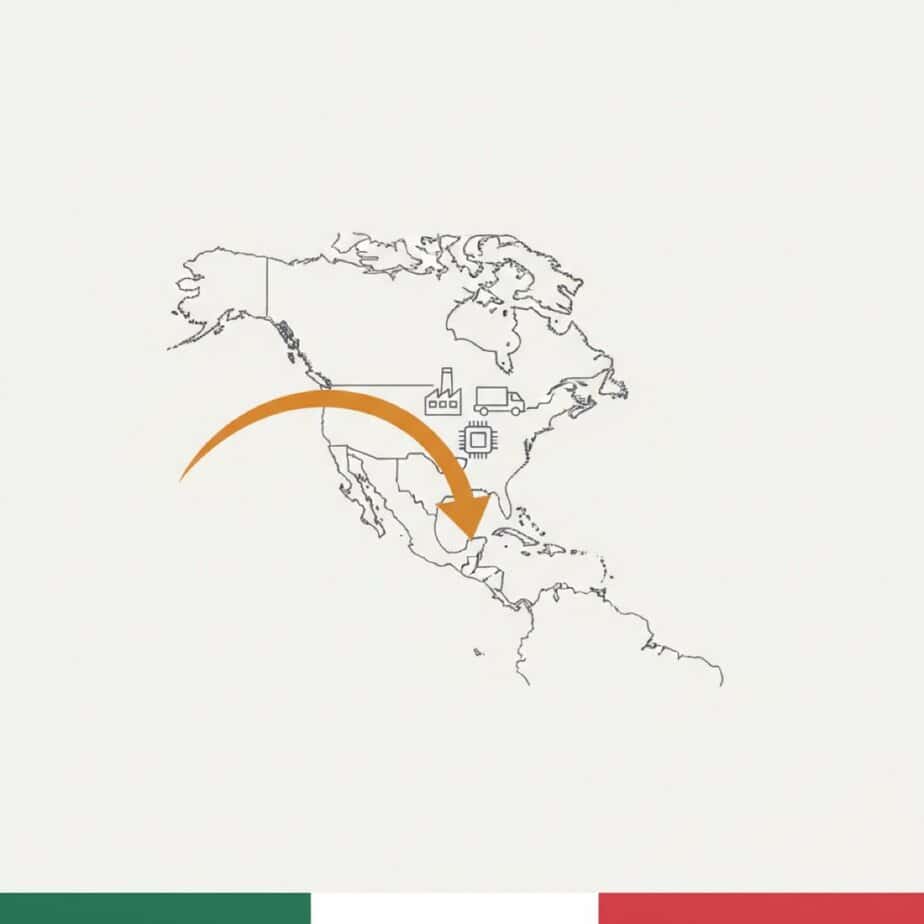
Nearshoring to Mexico is reshaping global supply chains. For thirty years, the rulebook for globalized companies was simple: make it in Asia, ship it to North America. That rulebook is being rewritten right now. Tariffs, pandemic-era supply shocks, geopolitical risk, rising Chinese wages, and a new generation of US trade policy have pushed hundreds of companies to ask the same question: Where can we make this closer to home?
The answer, for a growing share of them, is nearshoring to Mexico.
Mexico now exports more to the United States than China does. New industrial parks are filling before they finish construction. US tech companies are hiring software engineers in Guadalajara at a rate that would have been unimaginable five years ago. And the USMCA treaty — the successor to NAFTA — makes moving production south of the border easier than at any point in modern history.
This guide walks through what nearshoring to Mexico actually means in practice: the forces driving it, the real economic advantages, the industries leading the shift, where to set up, and how to enter the market without the 18-month slog most companies expect. If you’re evaluating Mexico as a production, service, or talent hub, start here.
What nearshoring to Mexico actually means
Nearshoring is the practice of relocating business operations — manufacturing, services, software development, back-office functions — from a distant offshore location (typically Asia) to a country geographically closer to your primary market. For US and Canadian companies, that country is almost always Mexico.
It sits on the same shelf as reshoring (moving operations back home), friendshoring (moving to politically allied countries), and China+1 strategies. In practice, for most North American companies, these terms all point to the same place on the map.
Nearshoring isn’t just manufacturing. It includes:
- Production of goods (electronics, automotive, medical devices, aerospace, consumer products)
- Software development and IT services (what the industry calls nearshore development)
- Customer support, BPO, and shared services
- Engineering, design, and R&D centers
- Logistics, warehousing, and distribution hubs
What unites them is a single insight: proximity has become more valuable than distance was cheap.
Why companies are nearshoring to Mexico — the five forces
Nearshoring isn’t a trend; it’s a structural shift pushed by five forces that are all pointing in the same direction.
1. USMCA replaced NAFTA with stronger incentives
The United States–Mexico–Canada Agreement (USMCA), in force since 2020, locked in duty-free trade for most goods between the three countries and tightened the rules that qualify a product as “Made in North America.” For sectors like automotive, the regional content requirement rose from 62.5% to 75%. That sounds like a hurdle, but the practical effect is to reward companies that move production into Mexico and penalize those that keep sourcing from Asia.
2. Tariffs and trade tension with China
Since 2018, successive US administrations have layered tariffs on Chinese imports across hundreds of product categories. Even where exemptions exist, the political risk of an overnight 25% tariff on Chinese-made goods is now permanent in every procurement conversation. Mexico, by contrast, enjoys tariff-free access to the US market under USMCA.
3. Rising labor costs in China
Chinese manufacturing wages have risen roughly 10x since 2000. The pure labor-arbitrage case for China — which was the entire basis for its manufacturing dominance — has largely evaporated for mid-value goods. Mexican manufacturing wages are now comparable to or below Chinese wages in many categories, and productivity has been climbing.
4. Supply-chain fragility
COVID taught a generation of operators that a 6-week sea voyage is a liability, not a cost center. A factory in Monterrey is 2–4 days from Dallas by truck. A factory in Shenzhen is 30+ days and one closed port away from being useless. CFOs who used to optimize purely for unit cost are now pricing in resilience, and that math favors Mexico.
5. US policy tailwinds
The CHIPS Act, the Inflation Reduction Act, and Section 232 tariffs have all created explicit and implicit incentives to onshore or nearshore production in semiconductors, EV batteries, solar, and critical minerals. Mexico, as a USMCA partner, often qualifies as “North American” for these incentive programs.
These aren’t temporary forces. They’re the reason foreign direct investment into Mexico hit record levels in 2023 and 2024 and continues to climb.
The real advantages of nearshoring to Mexico
The macro forces get the headlines. Here’s what actually makes Mexico work for the companies on the ground.
USMCA: tariff-free access to the world’s largest market
Under USMCA, qualifying goods produced in Mexico cross into the United States and Canada duty-free. No other major low-cost manufacturing country has this advantage. For a US importer, a truckload coming from Monterrey generally clears the border in hours; a container from Asia takes weeks and goes through a tariff calculation every time the rules change.
Proximity: days, not weeks
A factory in the Bajío region (Querétaro, Guanajuato, Aguascalientes) can feed an assembly plant in Texas or the US Southeast in 2–4 days by truck. Compare that to 30+ days from China, plus customs variability. For any product where inventory carrying costs, responsiveness, or just-in-time delivery matter, the difference is strategic, not cosmetic.
Timezone alignment: real-time collaboration
Mexico operates on Central Time for most of the country. A development team in Guadalajara starts their day at the same moment as a product team in Austin or Chicago. Stand-ups happen live. Issues escalate in minutes. Most of the dysfunction that makes offshore software outsourcing painful disappears when your team shares your calendar. This is the hidden reason Mexican tech talent has been absorbed so aggressively by US software companies over the last five years.
Labor cost arbitrage
A skilled manufacturing operator in Mexico typically costs 40–70% less than the US equivalent. A senior software engineer in Guadalajara typically costs 40–60% less than their San Francisco or New York counterpart. These numbers shift with seniority and specialty, but the structural gap is large enough to change business-case outcomes without being so large that it triggers political pushback. Our labor cost calculator lets you model the fully-loaded cost of a specific role.
One note on language: avoid framing this as “cheap labor.” Mexican workers are productive, educated, and increasingly specialized. The right framing is labor cost arbitrage — the same skill at a lower price because of currency, cost of living, and market structure.
Deep, young talent pool
Mexico graduates more than 110,000 engineers per year — more per capita than the United States. Major universities including ITESM (Tec de Monterrey), UNAM, IPN, and UDG feed talent into manufacturing clusters and tech hubs. The workforce skews young, bilingual in the cities where foreign investment concentrates, and increasingly comfortable with the global standards that multinational operations require.
Cultural and business fit
North American business culture — contract-oriented, schedule-driven, relationship-valuing — maps more closely onto Mexican business culture than it does onto most Asian alternatives. The learning curve for foreign operators is real but shallow. English-speaking managers are common in executive roles. Legal and commercial structures will feel foreign but not alien.
USMCA isn’t the only door: IMMEX and shelter programs
For manufacturers specifically, Mexico’s IMMEX program allows duty-free temporary import of raw materials and components used for export production. Combined with the IMMEX shelter program — a turnkey arrangement where an existing Mexican operator runs your production under their license — manufacturers can be in operation in a few months instead of a few years.
Industries leading the nearshoring to Mexico shift
Not every sector moves at the same pace. These are the industries that have committed hardest to Mexico.
Automotive and EV supply chain
Mexico has been the world’s 7th-largest auto producer for years. Now, EV platforms, battery assembly, and supporting tier-1 and tier-2 suppliers are investing aggressively in the Bajío and northern Mexico. Tesla’s planned Nuevo León plant has pulled a long tail of suppliers with it.
Electronics and semiconductors
Consumer electronics assembly has been a Mexican strength for decades. Now, backend semiconductor operations, PCB assembly, and test-and-packaging facilities are migrating from Asia to take advantage of USMCA origin rules and US policy incentives.
Aerospace
Querétaro has built one of Latin America’s largest aerospace clusters, hosting Bombardier, Safran, Eaton, and a web of precision suppliers. Mexico exports over $10 billion in aerospace products annually.
Medical devices
Tijuana and the broader Baja California region are now among the largest medical device manufacturing hubs in the world, serving US and global health systems.
Software and digital services
US software companies hiring engineering teams in Guadalajara, Mexico City, and Monterrey now number in the thousands. This shift is one of the quieter parts of the nearshoring story, but arguably one of the most consequential for knowledge-work economics.
Consumer goods, apparel, and appliances
Apparel, furniture, white goods, and home appliances all shifted meaningful production out of China during the 2018–2024 period, with Mexico as the primary beneficiary.
Where to set up: Nearshoring to Mexico’s industrial geography
“Mexico” is not one place. Where you locate depends on what you’re doing.
- The Northern Border (Tijuana, Mexicali, Ciudad Juárez, Reynosa, Nuevo Laredo) — Closest to US markets. Strong for medical devices, electronics, and cross-border manufacturing that needs speed to the US. The original IMMEX/maquiladora heartland.
- The Bajío (Querétaro, Guanajuato, San Luis Potosí, Aguascalientes) — Central Mexico’s manufacturing corridor. Dominant in automotive, aerospace, and mid-tech manufacturing. Well-developed industrial parks and logistics.
- Monterrey and the Northeast (Nuevo León) — Heavy industry, steel, cement, and increasingly EV and battery assembly. The closest major Mexican city to Texas.
- Guadalajara and the West (Jalisco) — “Mexico’s Silicon Valley.” Dominant for electronics, software development, and tech services. Universities, talent, and quality of life pull foreign investment.
- Mexico City and surrounding State of Mexico — Largest consumer market, headquarters and professional services, financial hub.
- Yucatán and the Southeast — Emerging frontier; government incentives and new port infrastructure (Mérida, Progreso) are trying to shift investment south.
Choosing the region is usually the second-hardest decision after choosing the market-entry model. Talk to people on the ground before signing any lease.
How to enter: EOR, subsidiary, or IMMEX
Every nearshoring decision eventually lands on the same question: what legal structure do we use to operate in Mexico?
There are three main paths, and the right one depends on your time horizon and headcount plans.
Start with an Employer of Record (EOR) if you’re hiring 1–30 people, want to be live in weeks not months, and don’t yet want the overhead of a Mexican entity. An EOR employs your team legally in Mexico while you direct the work. It’s the fastest way to test the market, hire a software team, or start small.
Form a Mexican subsidiary if you’re committed to Mexico long-term, plan to hire more than ~30 people, want full control, or need a Mexican entity for reasons like invoicing local customers, owning real estate, or accessing IMMEX. Expect 3–6 months for full setup.
Go straight to IMMEX / shelter if you’re a manufacturer whose business case depends on duty-free temporary imports for export production. A shelter gets you operational under an existing IMMEX license in a few months; a standalone IMMEX gives you full control but takes longer.
We wrote a deeper comparison here: EOR vs PEO vs Subsidiary in Mexico. Most foreign operators start with an EOR and migrate to their own entity once headcount justifies it — the EOR buys you time to validate without gambling on the long lead time of entity formation.
Costs and timelines: what to actually expect when nearshoring to Mexico
The biggest misconception about nearshoring to Mexico is that it’s fast and cheap in a naive way. It’s faster and cheaper than the alternatives, which is a different statement.
Realistic timelines:
- First EOR hire live: 2–4 weeks from signed engagement.
- Shelter manufacturing operation running: 8–16 weeks, depending on complexity.
- Standalone Mexican subsidiary formed, fully compliant, and hiring: 3–6 months.
- Standalone IMMEX license granted: 4–8 months after entity formation.
Realistic cost structure:
- Fully-loaded labor cost — salary plus ~30% employer burden (IMSS ~25%, INFONAVIT 5%, payroll taxes 2–3%, vacation, aguinaldo, PTU).
- EOR fee — typically a monthly flat fee per employee on top of loaded labor cost.
- Entity formation — legal, notary, and accounting costs, plus minimum capital and local registration fees.
- Ongoing compliance — bookkeeping, SAT filings, IMSS/INFONAVIT filings, payroll, annual audit.
The Mexican minimum wage and mandatory employer obligations (aguinaldo, vacation premium, PTU profit sharing) are the floor for any labor calculation. Budget from there.
Common nearshoring to Mexico pitfalls to avoid
After a decade helping foreign companies start operations in Mexico, the same handful of mistakes come up again and again.
- Misclassifying employees as contractors. Mexican authorities aggressively reclassify long-tenure contractors as employees, creating large retroactive liabilities.
- Ignoring REPSE registration. After the 2021 outsourcing reform, any EOR or specialized-services arrangement must use a REPSE-registered provider. A non-REPSE arrangement creates joint liability for the client.
- Underestimating severance. Mexican severance can equal a full year of salary for long-tenure workers. Terminations need to be handled carefully and, ideally, with local counsel.
- Choosing the wrong region. Labor pools, logistics, and industry clusters vary dramatically. Guadalajara is not the right place for heavy auto manufacturing; Monterrey is not the right place for design-heavy software teams.
- Treating Mexico like a simpler version of the US. The legal, tax, and labor framework looks familiar but has sharp edges (CFDI invoicing, PTU, mandatory benefits, IMSS, outsourcing reform) that trip up companies that don’t invest in a real local partner.
- Picking a generic global EOR platform. Global platforms treat Mexico as one tile in a 150-country grid. The nuances — REPSE, the 2021 reform, IMMEX, severance rules, CFDI payroll receipts — require Mexico specialists, not a ticket queue.
How Start-Ops helps companies nearshoring to Mexico
Start-Ops is a Mexico-only market-entry firm. We help foreign companies go from “we’re thinking about Mexico” to “we’re hiring and producing in Mexico” as fast as the compliance reality allows — usually 9 weeks for an EOR start, a few months for a shelter manufacturing operation, and 3–6 months for a full subsidiary.
We cover the full stack under one roof: company formation, EOR and payroll, accounting and tax compliance, recruiting and HR, visas and relocation for foreign executives, fractional CFO support, and IMMEX/shelter setup for manufacturers. Our team is based in Guadalajara, works in English and Spanish, and is REPSE-registered for compliant EOR work.
The difference from a global EOR platform is simple: you talk to humans who know Mexican law cold, who pick up the phone, and who don’t disappear when the conversation graduates from “hire me a software engineer” to “we need to form an entity and set up IMMEX.” Most of our clients start with a small EOR engagement and expand into the rest of the stack as they commit to Mexico.
Frequently Asked Questions
Nearshoring to Mexico means relocating business operations — manufacturing, software development, services, or back-office functions — from a distant offshore country (typically China or elsewhere in Asia) to Mexico, which is geographically and commercially closer to the United States and Canada. It combines the cost advantages of offshoring with the proximity and timezone benefits of onshoring.
Five forces are converging: the USMCA treaty gives Mexican production tariff-free access to the US, tariffs and geopolitical risk have made China more expensive and less predictable, Chinese wages have risen to the point where Mexican labor is competitive, supply-chain shocks have made distance a liability, and US policy programs like the IRA and CHIPS Act reward North American production.
Skilled manufacturing operators typically cost 40–70% less than US equivalents. Senior software engineers typically cost 40–60% less than their US counterparts. Fully-loaded cost — including the roughly 30% employer burden for IMSS, INFONAVIT, payroll taxes, aguinaldo, and PTU — still produces significant savings. Use a labor cost calculator to model specific roles.
It depends on the model. With an Employer of Record, the first hire can be live in 2–4 weeks. A shelter manufacturing operation can be running in 8–16 weeks. A standalone Mexican subsidiary typically takes 3–6 months to form and become fully operational. An IMMEX license adds another 4–8 months on top of entity formation.
No. An Employer of Record can legally employ workers on your behalf in Mexico while you direct the day-to-day work. This is the fastest and lowest-risk way to start. Most foreign companies use an EOR for the first 12–24 months, then migrate to their own subsidiary once headcount justifies the overhead.
It depends on the industry. Northern border cities (Tijuana, Ciudad Juárez, Reynosa) are strong for electronics and medical devices. The Bajío (Querétaro, Guanajuato) dominates automotive and aerospace. Monterrey leads heavy industry and EV manufacturing. Guadalajara is the software and electronics hub. Mexico City anchors consumer, financial, and professional services.
IMMEX is Mexico’s program for manufacturers that temporarily import raw materials and components to produce goods for export. It allows duty-free and VAT-deferred imports, making export manufacturing significantly cheaper. If your business case depends on importing inputs to produce goods that leave Mexico, you’ll likely want IMMEX — either through your own license or by operating under an existing shelter program.
Ready to Nearshore to Mexico?
Nearshoring to Mexico is a strategic decision, not a vendor-selection exercise. The companies that get it right invest early in understanding their options — EOR vs subsidiary, Bajío vs Monterrey vs Guadalajara, IMMEX vs standalone, single hire vs full operation — before they commit to a path. The companies that get it wrong usually picked a generic global platform, misclassified workers, or underestimated compliance, and spent the next two years cleaning it up.
If you’re evaluating Mexico and want a straight conversation about which model fits your situation, book a call with our team. We’ve been helping foreign companies start operations in Mexico for over a decade, and we’d rather tell you the honest answer — including “wait” or “do it differently” — than sell you the wrong service.